
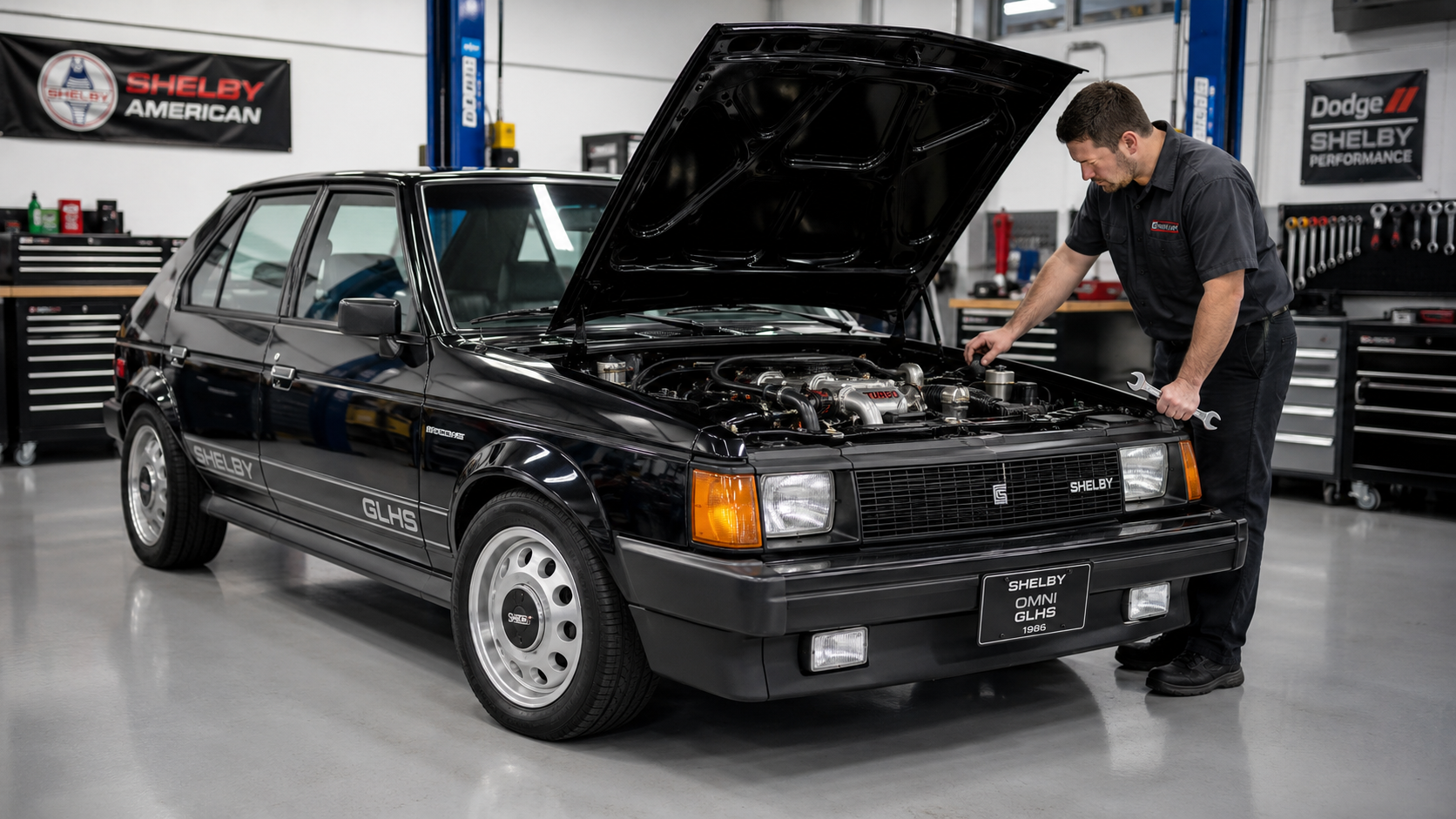
Most enthusiasts believe a vintage 2.2L or 2.5L engine is destined to leak, stall, or break, but the truth is that Chrysler's 1980s engineering shortcuts just need a 2026 mechanical update. You didn't save that Shelby Charger or Omni GLH from a field just to watch it collect dust while you hunt for your third head gasket of the season. You want to know how to make a turbo dodge reliable so you can actually enjoy the boost. It's frustrating when you're stuck dealing with the "chocolate milk" oil of a failed seal or the vague, sloppy feel of a worn out A525 transmission shifter linkage. We've all been there, staring at a 40 year old wiring harness and wondering which electrical ghost is killing the spark today.
I have spent years under these hoods and I promise you can transform your L-body or K-car into a dependable performer that starts every single time. We are going to master the specific weak points of these platforms, from the fast burn 782 cylinder heads to the critical cooling rituals required for longevity. This survival guide previews the essential upgrades, like custom L-body shift rods and A555 conversion brackets, that turn these cars from project headaches into confident machines. You'll learn exactly which parts to replace and which ones are worth refurbishing to keep your Dodge on the road instead of the trailer.
The reputation of the Turbo Dodge often suffers from a misunderstanding of 1980s technology. Critics claim these cars were poorly designed, but they actually pushed the limits of what was possible with early EFI and turbocharging. The real issue is that 40 years of heat soak in cramped L-body and K-car engine bays has taken its toll. Understanding how to make a turbo dodge reliable starts with recognizing that age, not just architecture, is your biggest opponent. The Chrysler 2.2 & 2.5L engine family is a stout platform, but it requires specific attention to survive another decade. You can't expect a car built in 1986 to run like a 2026 model without refreshing the core systems first.
You can't tune for power until you tune for reliability. This is the "Stage 0" rule. Before you even think about turning up the boost, you must assess the health of your engine. Start with a baseline compression test and a leak-down test. If your cylinders show more than a 10% variance, you aren't ready for performance upgrades. Check your factory wiring and vacuum lines immediately. Most 2.2L and 2.5L engines still run on 40 year old plastic that is ready to crumble. If your vacuum system fails, you risk a lean condition that will melt a piston in seconds. Get your foundation solid first!
Factory head gaskets were the Achilles' heel of these cars. The original composite gaskets often failed because the factory head bolts would stretch over time. This led to the dreaded "chocolate milk" oil and overheated blocks. Another major issue is the brittle plastic vacuum harness. These lines crack and cause erratic idling or dangerous boost spikes. Don't ignore your grounding straps either. Corrosion on these wires messes with the SBEC, SMEC or LM signals, leading to mysterious stalling. Replacing these with 4-gauge wire is a simple fix that solves many electrical gremlins. Check these specific areas:
By addressing these legacy issues, you move past the myths and start building a car that can handle modern driving. It isn't about fixing a "bad" engine; it's about finishing the job Chrysler started decades ago.
Bulletproofing a vintage 2.2L or 2.5L engine isn't just about throwing new parts at a problem. It's about correcting factory oversights with modern materials. If you want to know how to make a turbo dodge reliable, you have to start with the clamping force of the cylinder head. The factory composite gaskets were designed for 7 to 9 psi of boost. When you push beyond that on 40-year-old head bolts, they stretch. This leads to a lifted head and a blown gasket. Switching to a contemporary high quality composite (Fel-Pro Perma Torque), a "Metalmix" hybrid metal/composite head gasket or a multi-layer steel (MLS) gasket combined with high-strength head studs is a non-negotiable step. This setup provides the sealing power needed to handle 15 psi or more without breaking a sweat.
The 782 "Swirl" casting is the 86+ standard for these builds. It was designed to improve combustion efficiency and low-end torque. However, heat is a constant threat. These heads are notorious for developing hairline cracks between the valve seats. You must have any core pressure tested by a professional before you spend a dime on assembly. A surfaced and rebuilt head ensures a perfect seal against the block. Owners with real-world experience with the Shelby GLHS know that a healthy head is the difference between a fun weekend and a tow truck bill. If your current casting is beyond repair, we offer fully machined Turbo Dodge 782 cylinder heads that are ready for installation.
Heat soak ruins engine components. A 180-degree thermostat is a mandatory upgrade to keep your baseline temperatures manageable. Most stock radiators from the 1980s are likely 50% clogged with scale and debris by now. If you have an old school radiator shop in your area, it might be worth having your radiator tested for flow and cleaned if they can offer that service should yours not be flowing well. Replacement aluminum radiators are a good option if you can find one. This keeps the coolant moving and prevents hot spots in the back of the block. Mastering these cooling essentials is the biggest hurdle in learning how to make a turbo dodge reliable for daily use.
Your oil choice also matters. Use a high-quality synthetic oil. A 10W-30 weight works for most climates, but a 15W-50 is better for high-heat summer driving. If you're running a turbocharger, a 60-second cool-down period at idle is strongly suggested if not mandatory after every drive. This prevents the oil from coking inside the bearing housing. Combine this with a modern Walbro/TI Automotive 190 or 255 lph fuel pump to prevent lean-out conditions. A steady supply of fuel and cool oil will keep your 2.2L or 2.5L running strong for another 100,000 miles.
Reliability isn't just about the engine block. If you can't find third gear or your transmission explodes under boost, your car isn't dependable. The A525 manual transmission is the "glass fuse" of the Turbo Dodge world. Chrysler designed it for lightweight, low-torque applications in the early 1980s. When you start following our advice on how to make a turbo dodge reliable by increasing efficiency, that old A525 becomes a liability. It simply wasn't built to handle the torque of a modified 2.2L engine. Beyond the internal gears, the factory shift rod linkage (and on non L-body cars the plastic shift cable ends) are notorious for failing at the worst possible moments.
The factory shift linkage is a disaster of plastic clips and rubber bushings. After 40 years, these parts are usually brittle or missing entirely. This creates the "searching" feeling where you hope you've found the right gear. Missing a shift under boost isn't just embarrassing; it can over-rev your engine and cause catastrophic damage. Our custom-manufactured Turbo Dodge Parts L body shift rods replace those weak points with stainless steel rods and/or precision heim joints.
Heim joints provide a mechanical advantage by eliminating the "give" found in OEM rubber. You get a direct, bolt-on connection that offers a crisp, bolt-action feel. In a side-by-side comparison, the OEM linkage allows for nearly an inch of play in the shifter handle. Our heim-jointed rods reduce that to almost zero. You won't miss a gear again!
When the A525 finally gives up, most enthusiasts move to the A520, A555 or even the later A568 gearboxes. These are much stronger units designed for the Turbo II and later applications. The challenge is that these transmissions don't bolt directly into an L-body chassis without help. You need specific geometry to keep your shift rods and levers aligned and your shifter working correctly. This is a critical part of how to make a turbo dodge reliable because a stronger gearbox handles the stress of daily driving and track days alike.
We specialize in L body A525 to A520/A555 conversion brackets that make this swap a weekend project. Using the right brackets ensures your shift cables have the correct throw and tension. Don't forget poly engine mounts while you're in there. Factory rubber mounts allow the engine to rock back and forth, which puts massive stress on your shift linkage and CV axles. Polyurethane mounts keep the drivetrain stationary. This protects your hard parts and ensures your shifting precision remains consistent every time you drop the clutch.
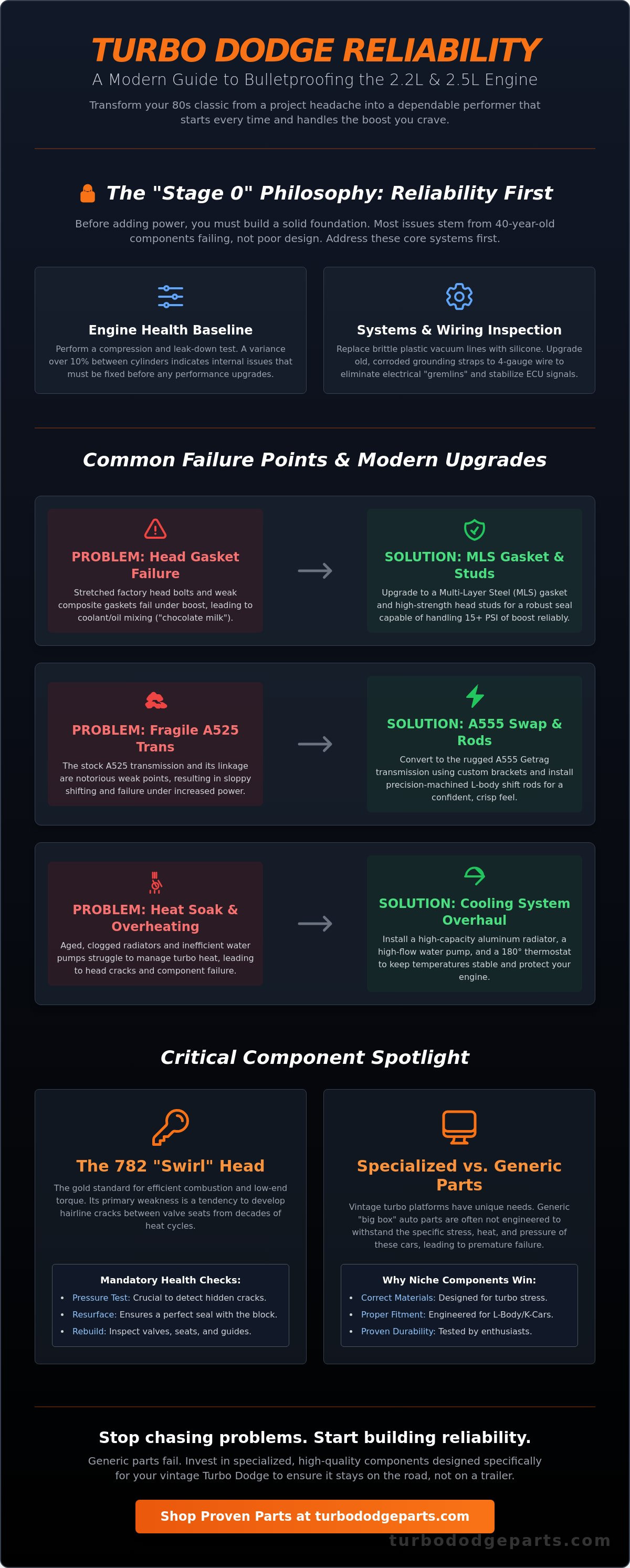
Executing a "Stage 0" refresh is the most critical phase of your project. This isn't about guesswork. It's a systematic approach to how to make a turbo dodge reliable by eliminating 40 years of entropy. You've already addressed the cylinder head and the gearbox in previous steps. Now it's time to focus on the support systems that keep the engine alive under load. If your fuel pump dies at 40 psi of fuel pressure, it doesn't matter how strong your head studs are. You need a baseline that you can trust every time you turn the key.
Electrical gremlins often stem from the bulk-head connector. Unplug it and clean every pin with electronics cleaner and a small wire brush. This prevents the intermittent stalling that plagues many L-body cars. While you're at it, consider replacing the capacitors in your Logic Module or Power Module. These components leak over time and cause erratic behavior. Simplifying your vacuum routing is another huge win. This eliminates "phantom" boost leaks that confuse the logic module and cause surging.
Ignition health is paramount. Inspect your distributor pickup, also known as the hall effect sensor, for signs of heat damage or melted plastic. You should also verify your fuel pressure under load. A healthy regulator must maintain steady pressure as boost rises. Don't use generic spark plugs from a local shop. Install the correct heat-range plugs, usually one step colder than stock for boosted builds, to prevent pre-ignition. If your engine is tired and needs a complete refresh, we offer Turbo Dodge rebuilt engines that come ready for your reliability upgrades.
Check your intermediate shaft gear while the timing belt is off. This gear drives the oil pump and distributor. If the teeth are sharp or hooked, it's a ticking time bomb. A failed gear means zero oil pressure in an instant. This checklist is your roadmap to a car that doesn't just run, but thrives. By following these steps, you ensure your 2.2L or 2.5L setup remains stable and predictable. You're building a car that can actually handle the road!
Finding parts for a 40-year-old Shelby Dodge in 2026 is a constant challenge. Most critical components are now classified as No Longer Available (NLA) through traditional Chrysler dealer networks. If you walk into a generic "big box" auto parts store, the staff will likely hand you a component designed for a naturally aspirated K-car. These parts aren't built to survive the extreme heat cycles of a turbocharged engine bay. Relying on low-grade sensors or alternators is the fastest way to undermine your work on how to make a turbo dodge reliable. You need specialized components that respect the original 1980s engineering while utilizing modern manufacturing tolerances.
Building a "spares kit" is a smart move for any long-distance enthusiast. You should never leave home without a spare hall effect sensor, a starter relay, and a few feet of silicone vacuum line in your trunk. These small items are often the difference between a quick roadside fix and an expensive tow truck bill. Proactive preservation ensures your L-body or K-car remains a driver rather than a driveway ornament.
There is a difference between a stock non-turbo 2.2L head and a performance-prepped 782 turbo head. A non-turbo head might look the same, but it lacks the specific combustion chamber geometry required for more efficient boost. We focus on providing 782 heads that are surfaced and pressure tested to ensure they won't fail under pressure. Similarly, our custom-manufactured Turbo dodge L body shift rods are a "one and done" fix. Our rods use precision heim joints that will likely outlast the car itself. When it comes to the block, choosing a professionally rebuilt engine over a "garage-built" gamble is the best way to ensure your project stays on the road for another 100,000 miles.
You don't have to hunt for these parts alone. I'm Steven, and I've spent years sourcing and manufacturing the specific pieces needed to keep these cars alive. If you are searching for a component that seems impossible to find, I encourage you to use our "Customer Reserved" service. This personalized interaction allows us to find niche items for one-on-one projects that aren't in the general catalog yet. My goal is to be a mentor for your restoration and a reliable source for your "Stage 0" refresh. This community is fueled by passion, and we're here to help you succeed in how to make a turbo dodge reliable for years to come!
Browse our inventory of reliability-focused Turbo Dodge parts!
You now have the roadmap to move your project out of the driveway and onto the open road. Transforming these 1980s icons into dependable machines means focusing on the "Stage 0" essentials like grounding and vacuum integrity. By upgrading to a 782 "Swirl" head and replacing sloppy factory linkage with heim-jointed rods, you address the root causes of most common failures. Mastering how to make a turbo dodge reliable is about using specialized components that can actually handle modern driving conditions.
Don't settle for generic parts that weren't built for a turbocharger's heat. We specialize in L-body and K-car platforms and offer custom-manufactured components you won't find at a generic retailer. If you get stuck, you have direct access to expert support via our shop phone. We are here to help you preserve this unique era of Chrysler history. Upgrade your Turbo Dodge today with expert-built parts!
It's time to stop worrying about your next tow and start enjoying the boost again. Your Omni, Daytona, or Charger is ready for its next chapter. See you on the road!
Yes, the 2.2L Turbo is an excellent daily driver if you prioritize cooling and electrical health. These engines often reach 200,000 miles when owners follow strict synthetic oil intervals and 180-degree thermostat swaps. Learning how to make a turbo dodge reliable for the commute means addressing 40-year-old vacuum leaks first. Once you baseline the car, it handles modern traffic without issue.
A metal/composite gasket like our high quality MetalMix head gasket or a multi-layer steel (Cometic/MLS) head gasket is the best choice for high-boost applications. These gaskets provide a superior seal compared to the original 1980s composite versions. You must combine this with high-strength head studs to prevent the head from lifting under pressure. This setup is mandatory for anyone running more than 12 psi of boost on a consistent basis.
Your L-body pops out of gear because the factory plastic shift linkage bushings have disintegrated. This creates excessive play that prevents the transmission from fully engaging the gear. Installing custom-manufactured shift rods solves this permanently. These rods provide a rigid mechanical connection that keeps the selector exactly where it belongs under heavy acceleration.
You need an A520 or A555 upgrade if you plan to exceed 150 horsepower or 175 lb-ft of torque. The A525 is a lightweight unit that often fails at the differential pin or input shaft bearing. Upgrading to the A555 provides a significant strength increase for modified builds. We offer specific conversion brackets to make this swap possible in your L-body chassis.
Blue smoke from the tailpipe and excessive shaft play are the primary signs of a failing turbocharger. You might also find oil pooling in your intercooler or intake piping. If you hear a high-pitched "dentist drill" sound under boost, the compressor wheel is likely contacting the housing. Inspect these components every 10,000 miles to catch issues before they cause engine damage.
No, you should never use 87 octane fuel in a turbocharged Chrysler engine. These engines require 91 or 93 octane to prevent pre-ignition and detonation under boost. Lower octane fuel causes the computer to pull timing, which reduces performance and increases exhaust gas temperatures. High-quality fuel is the simplest way to maintain long-term engine health and prevent melted pistons.
Stalling at operating temperature is usually caused by a failing Hall Effect sensor or a corroded bulk-head connector. These components often work fine when cold but fail as heat increases the electrical resistance. This is a key step in how to make a turbo dodge reliable for summer driving. Clean your electrical pins with a wire brush and verify that your sensor isn't suffering from 40 years of heat soak.
You can find a replacement 782 cylinder heads right here in our specialized inventory. These "Swirl" heads are the preferred casting for both 2.2L and 2.5L engines due to their combustion efficiency. We pressure test and surface our heads to ensure they are ready for installation. Don't risk a "garage sale" find that might have hidden cracks between the valve seats.