Your factory rubber mounts are the weakest link between your engine's power and the pavement. You've likely felt that frustrating "thud" during a hard second-gear pull or watched your engine rock 3 inches in its bay under boost. It's a common headache for Shelby Dodge owners and performance builders alike. Those soft, 30-year-old factory bushings just can't handle modern torque levels. Upgrading to poly engine mounts is the most direct way to lock that drivetrain down. You know that a stable engine means better shifts and consistent launches, but you shouldn't have to guess which setup works for your daily driver or track toy.
We're going to show you how polyurethane transforms your build by eliminating wheel hop and protecting your precious axles from shock loads. You'll discover if the performance gains outweigh the increase in cabin vibration for your specific project. This guide breaks down the technical differences in durometer ratings and explains why these mounts are a mandatory safety item for any high-boost L-body or G-body. Let's get your power to the ground where it belongs!
Polyurethane engine mounts are high-performance alternatives to the soft, compliant rubber components installed at the factory. While original equipment is designed to prioritize cabin comfort, performance enthusiasts need something stronger. An engine mount serves a dual purpose. It must balance vibration dampening with structural rigidity. Factory rubber is often the weak link in a classic 2.2L or 2.5L turbo setup because it allows for excessive movement. This flex absorbs energy that should be going to the wheels, which reduces the efficiency of your power transfer.
Mount technology has changed significantly since the 1980s. Original 1984 Chrysler standards focused on isolating the driver from the engine at all costs. Modern poly materials allow for a much tighter tolerance than those 40 year old designs. Today's poly engine mounts use specific durometer ratings, often ranging from 70A to 90A, to provide a middle ground that 1980s engineers didn't utilize for street cars. This evolution means you can now keep the engine stable without the bone-shaking harshness of a solid metal mount.
A performance mount consists of three main parts. The central steel sleeve handles the mounting bolt and provides a pivot point. The polyurethane bushing surrounds this sleeve to absorb high-frequency shocks. Finally, the outer shell holds the assembly within the K-frame or chassis bracket. You'll often see "inserts" on the market. These are poly pieces designed to slide into the empty voids of a factory rubber mount to stiffen it up. Full replacement poly engine mounts replace the entire rubber unit for maximum control. These components are vital for maintaining drivetrain alignment. Proper alignment prevents premature wear on your CV axles and ensures your shift linkages stay precise during hard cornering.
You can usually spot a failing mount during a quick under-hood inspection. Look for visible cracking in the rubber or signs of dry rot. Performance cues are even more obvious to the driver. You'll hear a heavy clunk during hard shifts or feel the car buck when you suddenly lift off the throttle. Engine rock is the unwanted rotation of the block under torque. If you see the valve cover moving more than an inch toward the firewall when you rev the engine, then at the very least your front engine mount is shot and needs an upgrade.
You can use the following guidelines to determine if your turbo Dodge is in need of some new poly blood in place of the original natural rubber mounts.
Factory mounts use natural rubber for a specific reason: it's cheap and soft. Manufacturers prioritize a quiet cabin over raw power delivery. Rubber works by absorbing energy, but it has a fatal flaw in a performance environment. It's an organic material that begins to break down the moment it leaves the factory. Heat cycles from a 2.2L and 2.5L turbo engine and constant exposure to the elements cause rubber to "dry rot" and crack. Once the structural integrity fails, your engine starts bucking, which kills your 60-foot times and ruins shift precision.
Polyurethane is a synthetic elastomer designed for resilience. Unlike rubber, poly has "memory." When you drop the clutch and send 300 lb-ft of torque through the drivetrain, the material compresses to absorb the shock. Once the load is released, poly engine mounts return to their original dimensions instantly. They don't take a permanent "set" or sag over time like old rubber blocks. This ensures your drivetrain alignment stays true during high-stress maneuvers.
We grade the stiffness of these mounts using the Shore A durometer scale. Choosing the right number is the difference between a fun street car and a vibrating nightmare. Most enthusiasts find their sweet spot in these three categories:
Engine bays are hostile environments. If you've ever dealt with a weeping valve cover gasket or a pinhole coolant leak, you know how messy things get. Standard rubber is porous. It absorbs engine oil and antifreeze, which causes the material to "melt" and turn into a black, gooey mess. Once a rubber mount is oil-soaked, it loses its ability to hold the engine steady.
Polyurethane is chemically inert to most under-hood contaminants. Oil, grease, and road salt won't penetrate the surface. This durability means you won't be replacing these parts every three years. While a set of poly engine mounts costs more upfront, they represent a "one and done" solution for your restoration. If you're tired of replacing rotted factory insulators, consider browsing over to PolyBushings.com and shop their catalog for turbo Dodge specific engine and transmission mounts. You'll likely find that these mounts outlast the vehicle's chassis, saving you both labor and cash in the long run.
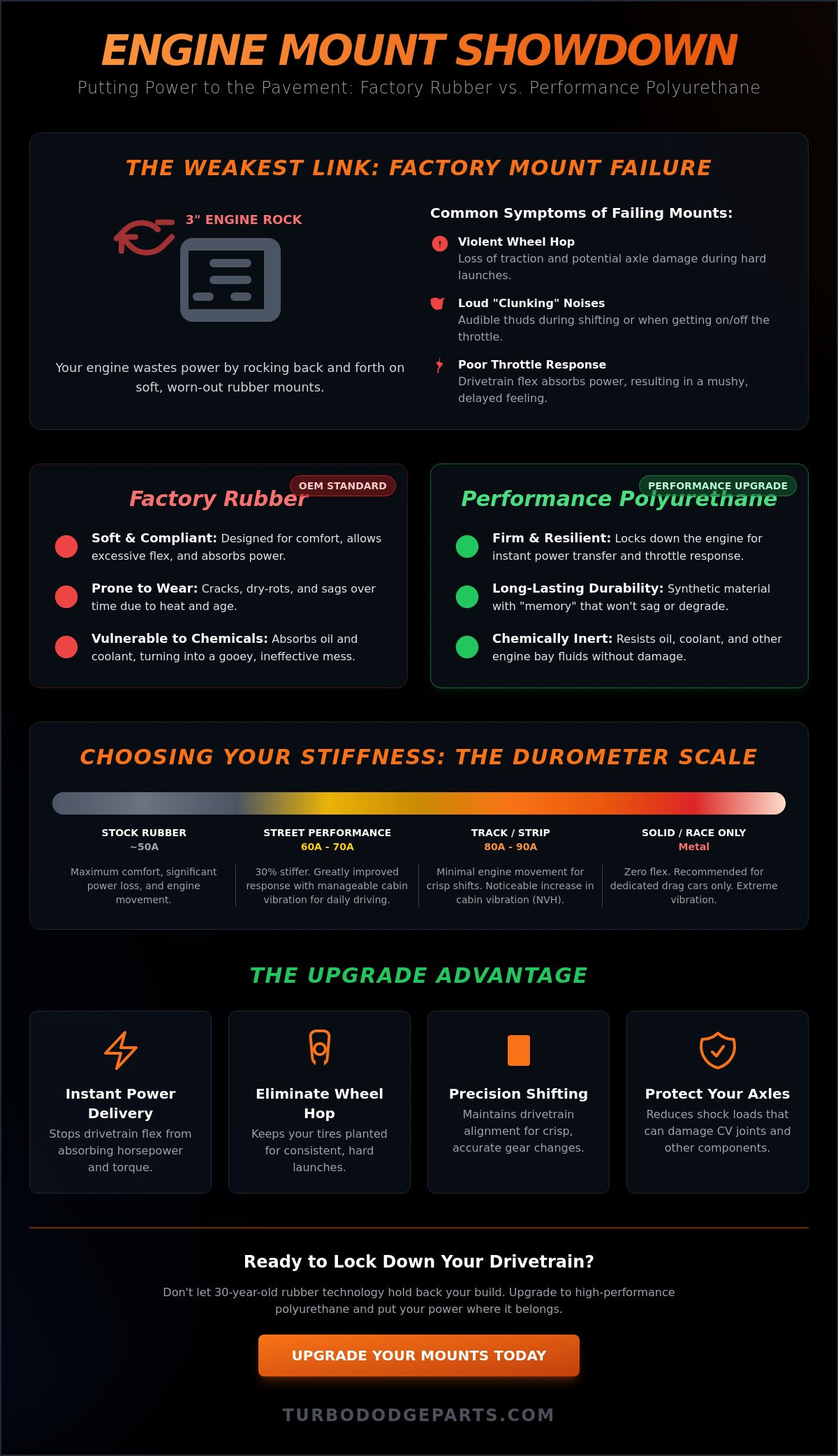
Wheel hop is the primary enemy of traction in front-wheel-drive platforms like the L-body and K-car. When you launch a high-torque turbo Dodge, the engine naturally tries to rotate in the opposite direction of the wheels. Factory rubber mounts are designed for comfort, not performance, and they allow the engine to twist significantly. This creates a violent "loading and unloading" cycle. The tires grip the pavement, the rubber mounts stretch to their limit, and then they snap back like a rubber band. This causes the tires to lose and regain traction rapidly, resulting in the shaking and banging known as wheel hop.
Installing poly engine mounts stops this cycle at the source. Polyurethane is a much denser material than factory rubber. It limits engine rotation to a fraction of an inch, ensuring that the downward force stays on the tires rather than being absorbed by the mounts. By stabilizing the drivetrain, you keep the contact patch flat against the asphalt. This leads to more consistent 60-foot times and prevents the drivetrain from shaking itself apart during a hard launch.
Beyond traction, poly mounts serve as a critical insurance policy for your drivetrain. Every time your car hops, your CV axles and half-shafts are subjected to massive shock loading. This erratic stress is exactly what causes cages to shatter and splines to twist. By removing the engine's ability to bounce, you protect these hard-to-find 1980s-era components from premature failure.
Torque steer occurs when power is distributed unevenly, often pulling the steering wheel to one side under heavy boost. In a front-heavy Shelby Dodge, engine movement under load changes the operating angles of your half-shafts. When the engine tilts back, the axles no longer sit at their optimal geometry. Increased mount rigidity maintains consistent axle geometry to prevent the side-to-side pulling common in high-boost FWD setups. This stabilization ensures that both front wheels receive equal force, keeping your Daytona or Omni tracking straight when the turbo hits 15 PSI or more!
If you've ever missed a gear during a hard pull, the problem might be your engine position, not your transmission. L-body cars utilize a rod-style shift linkage that is sensitive to engine movement. Because the linkage is connected between the stationary chassis and the moving engine, any "pitch" during acceleration moves the shift gates. This makes the shifter feel vague or "sloppy" exactly when you need precision.
Using poly engine mounts transforms the driving experience by turning a vague gear selector into a precise tool. You won't have to "hunt" for third gear anymore because the engine stays exactly where it belongs.
Upgrading to poly engine mounts changes how your car interacts with the pavement. NVH stands for Noise, Vibration, and Harshness. In the world of 1980s and 90s Chrysler performance, this is the difference between a quiet cabin and a vibrating rearview mirror. Polyurethane is a dense, non-porous material. Unlike factory rubber, it doesn't soak up engine harmonics. Instead, it transfers that energy directly into the frame. You'll feel the engine's power more clearly, but you'll also hear every mechanical cycle at a stoplight.
New poly engine mounts require a break-in period of roughly 500 miles. Don't judge the comfort level on the first trip around the block. The material needs multiple heat cycles and physical stress to settle into the brackets. During the first 100 miles, the stiffness is at its peak. After the break-in period, the polyurethane reaches its final operating density. The vibration often drops by 20% compared to the initial install, making the car much more manageable for street use.
Energy doesn't disappear; it just moves. Factory rubber mounts turn engine movement into heat through friction within the rubber molecules. Polyurethane resists this movement to keep the drivetrain aligned. This energy travels through the K-member and into the chassis. Chrysler 2.2L and 2.5L engines are four-cylinder units that lack the natural balance of a straight-six or a V8. They produce significant secondary vibrations that the driver will feel in the steering wheel and floorboards. To manage this, ensure your exhaust hangers are in good condition. A stiff exhaust system combined with poly mounts can act like a tuning fork, amplifying the buzz throughout the car.
Harshness is a personal choice. Many enthusiasts find the trade-off acceptable for the massive gain in throttle response. If your car idles below 800 RPM, the dash rattles will be more pronounced. Simply raising the idle to 900 or 950 RPM can eliminate nearly 60% of the cabin vibration, but this is not typical in the turbo Dodge computer controlled fuel injection and the idle adjustment screw has a tamper resistant cap over it that would have to be removed to make this type of adjustment. For owners of L-body or G-body cars, the front bobble strut is the most important upgrade point. This small torque strut handles the engine's rocking motion during hard shifts. Replacing just the bobble strut with a poly unit provides a 40% increase in shift precision without the full cabin vibration of a complete three-mount poly kit. It's the best way to test your tolerance for NVH before committing to a full set.
Deciding which mounts to upgrade first depends on your specific goals. For most front-wheel drive Mopars, the front torque strut takes the most abuse during acceleration. If you only replace one, start there. However, a complete set of poly engine mounts provides the best results for high-boost applications. Inspect your passenger side mount for sagging or oil saturation before you begin. If the engine sits crooked in the bay, your axles are likely under unnecessary stress.
Safety is the priority. Support the engine using a floor jack and a thick wood block placed under the oil pan. The wood distributes the weight so you don't dent the pan or crush the oil pickup. Once you've unbolted the bracket, you'll need to remove the factory rubber. Many enthusiasts use a propane torch to "burn out" the old rubber, which is effective but messy. A hydraulic press is a cleaner alternative if you have access to one.
After the mounts are in place, don't torque everything to 100 percent immediately. Thread the bolts in, lower the jack, and let the engine run for two minutes. This allows the assembly to find its natural center. Finalize your torque to factory Chrysler specifications.
Owners of L-body and K-car chassis face unique challenges. The passenger side mount on a 2.2L or 2.5L engine lives in a high-heat environment right next to the turbocharger. Heat soak can degrade even high-quality materials over time. Consider adding a small heat shield if you're running a larger T3/T4 hybrid turbo. If you're performing an A555 transmission conversion, ensure your poly mounts are compatible with the specific brackets required for that beefier transaxle. The alignment of your shift linkages depends heavily on the engine sitting at the correct height and angle.
Ready to tighten up your shift feel and get that power to the ground? Check out our custom-engineered performance shift rods for all L-body 5 speed cars and keep your classic Shelby or Dodge project on the road!
Swapping out worn rubber for poly engine mounts transforms how your vehicle handles torque. Stock rubber components often degrade after 30 years of heat cycles, leading to excessive engine movement and destructive wheel hop. By installing polyurethane bushings, you secure the engine and transaxle to ensure that every bit of power reaches the wheels. While you'll experience a slight increase in cabin vibration, the gain in throttle response and drivetrain stability is undeniable for high-performance driving.
We've spent years testing hardware specifically for Chrysler 2.2L and 2.5L engine platforms to ensure every part holds up under pressure. Whether you're restoring a 1984 Omni GLH or building a 400-horsepower Spirit R/T, having the right mechanical components is the difference between a broken axle and a personal best at the track. We provide direct access to expert-tested hardware and hard-to-find engine assemblies designed for L-body and K-car enthusiasts who demand more from their machines.
Upgrade your drivetrain with Turbo Dodge performance parts and get your project back on the road today. It's time to stop fighting wheel hop and start enjoying the boost!
Yes, poly engine mounts increase cabin vibration because they're 20 to 30 percent stiffer than factory rubber. This stiffness prevents the engine from absorbing energy, transferring it directly to the chassis. You'll feel it most at idle or when the A/C kicks on. For a dedicated track car, this is a fair trade for better throttle response. On a daily driver, expect a noticeable buzz in the steering wheel.
Polyurethane mounts typically last 10 to 15 years or the remaining life of your vehicle. Unlike OEM rubber that cracks and dry-rots after 5 years of heat cycles, poly resists oil, ozone, and engine chemicals. These components won't sag over time. If you're restoring an 80s Shelby Dodge, installing these means you won't have to touch the mounting system again for a decade. It's a "one and done" upgrade.
You can expect a measurable improvement in your 0-60 times by reducing engine torque twist. When the engine stays stationary, power goes directly to the axles instead of stretching rubber mounts. Many drag racers see a 0.1 to 0.2 second reduction in their 60-foot times just by switching to poly engine mounts. It eliminates wheel hop, which is the primary killer of fast launches in front-wheel-drive platforms.
For a street-driven turbo car, a 70A to 80A durometer rating is the sweet spot. This hardness provides a 25 percent increase in stiffness over stock without making the car unbearable to drive. If you go higher, like a 95A track-spec bushing, the vibration will likely rattle interior plastics loose. Stick to the 70A range to keep your teeth from chattering while sitting at stoplights in your L-body.
You don't have to replace every mount at once, but mixing materials can cause issues. If you put a stiff poly mount in the front and leave a 30 year old rubber mount in the rear, the remaining rubber mount takes 50 percent more stress. This often leads to the old rubber failing within 1,000 miles. For the best drivetrain alignment, swap the entire set during one single weekend project.
Poly inserts work well if your original rubber isn't completely torn or separated. These inserts slide into the existing gaps of the OEM mount to limit movement. It's a quick 15-minute install that costs significantly less than full replacement housings. However, if your rubber is already crumbling, an insert won't fix the underlying failure. In that case, you need a full replacement poly engine mounts setup for safety.
Squeaking happens when the polyurethane rubs against the inner metal sleeve without enough lubrication. To fix this, use a high-quality marine-grade lithium grease or a PTFE-based lubricant during assembly. Don't use petroleum-based grease, as it can actually degrade some poly formulas over a 24-month period. Re-greasing the pivot points every 2 years will keep the engine mounts silent and moving smoothly without any annoying bird-chirp sounds.
Poly mounts are essential for any build pushing over 300 horsepower. High-torque engines can move 2 to 3 inches under heavy load, which risks snapping coolant lines or hitting the radiator. Polyurethane limits this movement to less than 0.5 inches. This stability protects your T1 intake and turbo plumbing from stress fractures. It's the standard choice for enthusiasts who want their power to reach the pavement safely and consistently.