
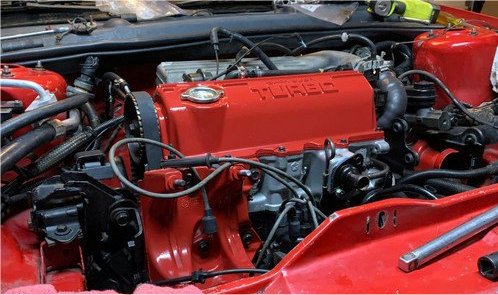
You walk into a local big-box auto store asking for a shift linkage bushing for a 1987 Shelby GLHS, and the clerk stares at his computer like you're asking for a flux capacitor. It's a common reality for those of us keeping Chrysler's turbocharged history alive; the generic parts bin just doesn't cater to L-body or K-car enthusiasts anymore. You know that a standard off-the-shelf component will likely fail the moment you hit 14 psi of boost on your 2.2L build.
We agree that these 80s and 90s legends deserve better than "close enough" fitment from a generic catalog. This guide from Turbo Dodge Parts shows you why specialized knowledge and niche, custom-manufactured components are the only way to keep your turbo auto projects performing at their peak. We'll explore how to eliminate sloppy shifting and boost leaks by sourcing reliable mechanical parts designed specifically for Shelby Dodge platforms. From Bathtub heads to T1 intakes, you're about to learn how to connect with the expert guidance needed to finish your restoration the right way!
Walking into a local auto parts chain today often feels like a dead end for owners of 1984 to 1993 Chrysler turbo vehicles. Most big-box retailers optimized their inventory systems for high-volume, modern commuters years ago. They stock maintenance-grade components designed for a five-year lifespan on a naturally aspirated sedan. These parts don't meet the needs of a high-strung 2.2L or 2.5L turbo engine. A "universal fit" vacuum line or a budget-grade head gasket might work for a grocery getter, but it's a liability under 14 psi of boost. Specialized performance-grade components are essential to handle the heat and pressure cycles unique to these forced-induction pioneers.
The risk of using generic hardware is real. Many national chains stopped carrying critical 80s and 90s Dodge hardware around 2010. When you use a part that "looks close enough," you risk catastrophic engine failure. Specialized vendors like Turbo Dodge Parts bridge this gap. We provide the specific mechanical DNA required to keep these legends on the road. Understanding the history of turbochargers helps you appreciate why precision matters. Early Chrysler turbo systems were advanced for their time, and they require exact tolerances that modern generic catalogs simply ignore.
Your local parts counter probably can't find an L-body shift rod because the part number was purged from their system a decade ago. National remanufacturing chains have largely abandoned the 782 "Swirl" cylinder heads, often labeling them as "obsolete" rather than "out of stock." This doesn't mean the part is extinct; it just means it isn't profitable for a corporate giant to shelf it. We track down these specific castings and components because we know their value to the community.
Historical accuracy is vital for a proper vintage auto restoration. A 40-year-old OEM bracket is often fatigued or rusted beyond repair. We solve this by custom-manufacturing rods, brackets, and fuel components that actually outperform the original factory pieces. You get parts designed by people who actually turn wrenches on Shelby Chargers and Daytonas.
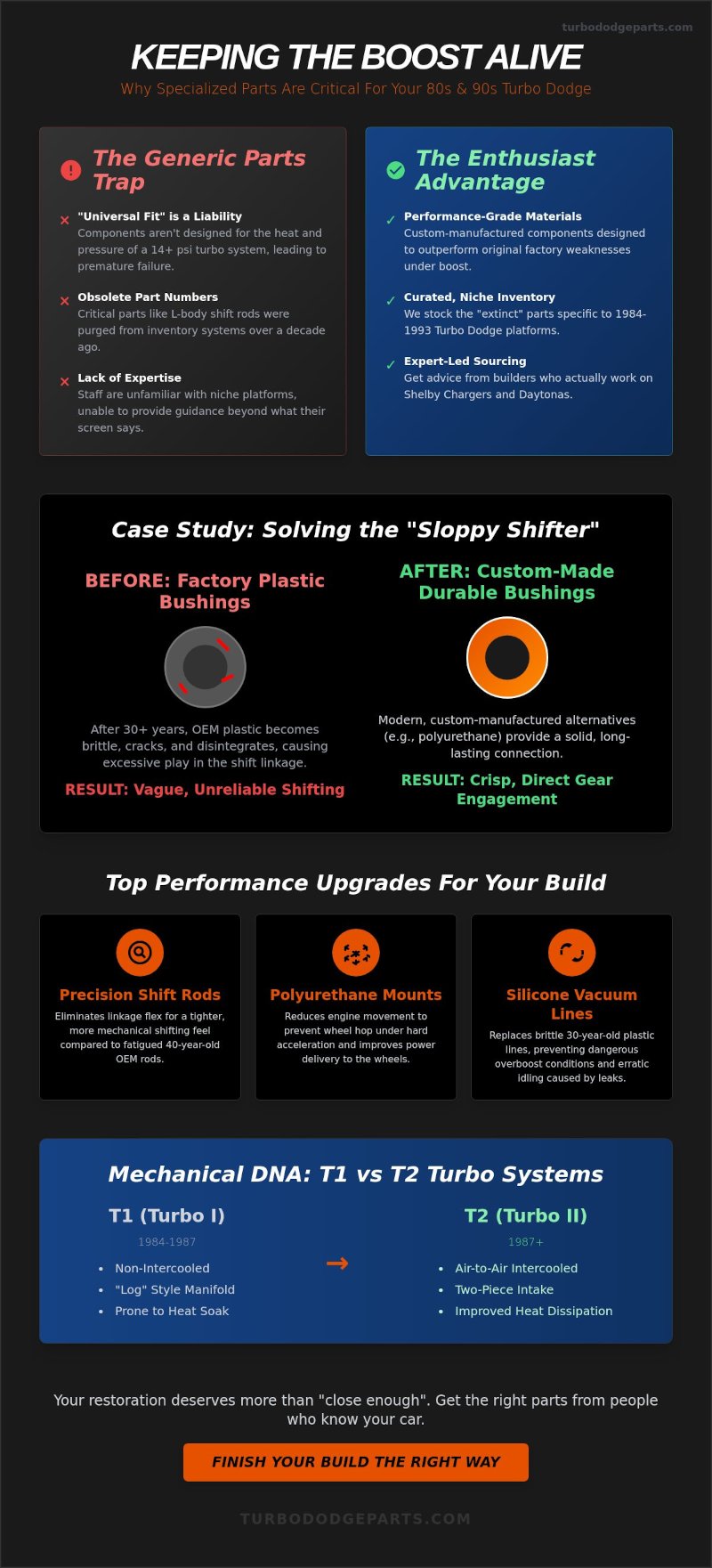
The foundation of every vintage auto build in this niche starts with the Chrysler 2.2L and 2.5L overhead cam engines. These four-cylinder powerplants defined an era of domestic boost, providing a modular architecture that allowed Chrysler to scale performance across dozens of models. Early T1 engines from 1984 to 1987 utilized a non-intercooled "log" manifold. This design was compact but restricted airflow significantly, limiting heat dissipation. By 1987, the transition to the T2 configuration introduced air-to-air intercooling and a two-piece intake manifold, which solved many heat-soak issues and allowed for higher sustained boost levels.
Aging vacuum systems remain the most frequent failure point for these platforms. Over 30 years of heat cycles turn the original plastic lines brittle, leading to cracks that cause erratic idling or dangerous overboost conditions. The wastegate solenoids often fail or become clogged with debris, preventing the computer from accurately controlling the turbocharger. Replacing these with high-quality silicone lines and testing the wastegate actuator is a mandatory first step before adding power. If you're hunting for specific components to refresh your vacuum system, browse the selection at Turbo Dodge Parts for your next project.
The "782" casting, commonly known as the "Swirl" head, debuted in 1986 and became the gold standard for street performance. Its heart-shaped combustion chamber creates a "Fast Burn" effect that improves efficiency and reduces the tendency to knock under load. While the older "G-head" offers better flow at high RPM, the 782 design provides the low-end torque necessary for a responsive auto build. When inspecting a garage-find head, look closely for cracks between the valve seats. These vintage castings are prone to heat stress. A professional rebuild with hardened seats and fresh guides is always a better investment than bolting on a used head of unknown origin.
Choosing between an L-body, like the Omni or Charger, and a K-car derivative, like the Daytona or LeBaron, changes your mechanical approach. The L-body is the lightweight champion, often weighing less than 2,200 pounds, but it features a cramped engine bay and a unique front engine mount. K-cars offer more room for larger turbo housings and more robust shift linkages. The Specialty Equipment Market Association notes that the demand for period-correct performance parts is rising as these platforms gain collector status. You must select a turbo housing that clears the firewall; L-bodies typically require a 2.25-inch swing valve to fit the tight exhaust tunnel without modification. The 1989 common block update further improved these platforms by adding cross-drilled cooling passages and a stronger crankcase design.
Building a vintage turbo Mopar requires more than just turning up the boost. You need a balanced approach to ensure your auto project stays on the road instead of on a trailer. These five upgrades represent the most effective ways to modernize your 2.2L or 2.5L drivetrain while maintaining reliability. Precision and strength are the names of the game when dealing with 1980s Chrysler hardware.
A tired factory wastegate actuator often causes "boost creep." This is where boost pressure rises uncontrollably as engine speeds increase because the wastegate can't bypass enough exhaust. Installing a fresh, high-flow unit ensures the flapper stays shut until the exact moment you want it to open. You should also inspect your turbo flanges and headers. Smoothing these transitions reduces exhaust backpressure, which allows the turbine to spin up faster and reduces heat soak. Boost threshold in the context of a 2.2L T2 engine is the specific engine speed where exhaust gas volume becomes sufficient to generate positive manifold pressure.
The A525 transmission is the primary weak link in any performance build. Its small gears and aluminum bearing retainers often fail under the stress of basic performance mods. To fix this, most enthusiasts perform an A555 swap. This conversion is a mandatory step for builds pushing over 200 wheel horsepower. You'll need custom conversion brackets to fit the beefier A555 into an L-body chassis correctly. Don't forget to upgrade to polyurethane control arm bushings at the same time. These bushings keep your alignment straight under heavy load, which drastically improves front-wheel-drive traction during acceleration.
If your Dodge Omni or Charger shifter feels like a bowl of oatmeal, you aren't alone. That vague, wandering sensation usually means your factory 1984 to 1990 linkage is shot. Diagnosing this is simple. If you can move the gear lever two inches in any direction while it's in gear, your bushings have likely disintegrated. Most vintage auto enthusiasts struggle with this because the original components weren't built to last forty years.
Factory plastic bushings fail because they're made of nylon that becomes brittle with heat and age. They eventually crack and fall out of the shift rod ends. Replacing them with identical plastic parts is a temporary fix that leads to the same failure down the road. A permanent overhaul requires a logical approach. Start at the transaxle and work back to the cabin. By replacing the rods and adjusting the gate alignment, you ensure the shifter hits the same spot every time. This prevents missed shifts that can over-rev your engine and cause catastrophic damage.
The best upgrade for any L-body is swapping OEM nylon-ended rods for custom-manufactured heim-joint versions. These use spherical bearings that offer zero play and won't rot. Installation in a Dodge Omni engine bay is tight, especially near the firewall. I recommend using a small 10mm ratcheting wrench to reach the linkage pins. Once installed, these rods require very little maintenance. A quick drop of dry lubricant on the joints every 5,000 miles keeps the action smooth. This is a foundational step in overcoming common vintage auto shifting issues.
Saggy rubber engine mounts do more than just vibrate. They allow the engine to rock excessively. This movement puts immense stress on your exhaust manifold and downpipe. I've seen many 1980s Turbo Dodges with cracked manifolds caused specifically by worn-out front mounts. Upgrading to polyurethane inserts offers a 60 percent increase in stiffness over stock rubber. While you'll feel more engine vibration in the steering wheel, the trade-off is better power delivery and saved hardware. For 5-speed transaxles, the "bobble strut" located at the rear of the case is critical. If this small shock absorber is blown, your engine will pitch forward during every hard shift, ruining your linkage alignment.
Ready to tighten up your drive? You can find the exact bushings and rods you need at turbododgeparts.com to get your project back on the road.
Finding parts for a 1985 Shelby Charger or a 1991 Spirit R/T isn't like walking into a big-box auto store. Most OEM components for these specific platforms vanished from dealer shelves by 2005. Our mission centers on keeping these 80s and 90s legends on the road by filling the gap left by major manufacturers. We specialize in the 2.2L and 2.5L overhead cam engines that defined the Chrysler front-wheel-drive performance era. Because we're enthusiasts first, we've spent years identifying which parts are prone to failure. We source or custom manufacture high-quality replacements that have been discontinued for over 30 years.
We ship these vital components to garages across the United States and to international fans every week. Whether you're located in a major metropolitan area or a remote rural community, across the United States or internationally, you have access to the same specialized inventory. We don't act like a faceless auto corporation. We operate as a dedicated partner in your restoration project, ensuring that the heritage of Carroll Shelby’s collaboration with Dodge remains visible on the streets and at the track.
You won't get a computerized menu or a scripted call center when you reach out to us. You get Steven. This direct line to a specialist means you're getting advice from someone who actually turns wrenches on these specific machines. Personalized service is the backbone of what we do. We help customers with custom engine builds, part matching for rare configurations, and troubleshooting for complex vacuum or electrical issues. If you're trying to figure out which fuel injectors match your specific computer calibration, we provide the technical clarity you need.
This specialization is intentional. We focus exclusively on passenger cars like the Omni GLH, the Daytona, and the various Shelby-tuned Lancers and Shadows. While other shops focus their energy on the truck market, we leave the pickups to the other guys. By narrowing our focus to the L-body, G-body, and J-body platforms, we ensure our expertise isn't diluted. This allows us to maintain a deeper knowledge of the unique quirks found in 1984 to 1993 Chrysler turbo systems.
Our inventory covers the full spectrum of restoration needs. We stock everything from 782 Swirl heads to complete, professional-grade rebuilt engines. Quality control is our priority because we know these cars are more than just transport; they're pieces of history. We also support the DIY community with our "Garage Sale" section. This area of our shop features rare, one-off finds and used items that are no longer in production. It's the perfect resource for the mechanic who needs a specific bracket, sensor, or trim piece to finish a factory-correct restoration.
We take pride in being a "parts hunter" for the community. If a component is essential for a 2.2 Turbo I or Turbo II setup, we make it our business to have it in stock. Our commitment to quality ensures that every part, whether it's an aftermarket upgrade or a refurbished original, meets the demands of high-performance driving.
Reviving a classic 1980s or 1990s Shelby Dodge requires more than just luck. It takes a deep understanding of the 2.2L and 2.5L engine platforms that defined a unique era of American performance. You've seen how to move past the limited inventory of big-box retailers to address specific mechanical hurdles like the notorious sloppy shifter. Maintaining these discontinued Chrysler platforms is a labor of love; however, you don't have to hunt for rare components alone. We're a privately owned shop operated by 2.2L and 2.5L specialists who live and breathe these machines every day.
Our inventory features custom-manufactured hardware designed specifically for L-body and G-body vehicles that the rest of the industry forgot years ago. If you hit a wall during your build, you can reach us directly by phone or email for technical support. It's time to give your vintage auto the precision parts it deserves to stay on the pavement for another decade. We look forward to seeing your project back in the boost!
Browse our specialized Turbo Dodge L-body and engine parts today!
Yes, you can still source New Old Stock (NOS) and custom-manufactured components for these 40-year-old vehicles. We maintain an inventory of over 500 unique SKUs specifically for the 1984 to 1993 model years. While Chrysler ended most factory support by 2005, the enthusiast community and specialized vendors like us keep these cars on the road with high-quality replacements.
Excessive play in your L-body shifter is usually caused by worn nylon bushings in the shift linkage or a degraded selector pin. These original plastic parts often crack after 30 years of heat cycles and friction. Replacing them with our custom-machined steel or high-density plastic components reduces shifter throw play by 60 percent, providing the precision needed for an Omni GLH or Shelby Charger.
You shouldn't use generic auto parts for high-stress areas like head gaskets or rod bearings in a turbocharged application. Standard naturally aspirated 2.2L components aren't designed to withstand the 7 to 14 psi of boost generated by a T2 Garrett turbocharger. Always use specialized multi-layer steel gaskets and forged components designed for 1986 to 1993 turbo blocks to prevent catastrophic engine failure.
The 782 "Swirl" head, introduced in 1986, features a combustion chamber design that promotes better fuel atomization at lower RPMs. This "Fast Burn" technology improves low-end torque and thermal efficiency compared to the earlier "Bathtub" G-head designs. It's the preferred choice for 2.2L and 2.5L builds where street driveability and mid-range power are the primary goals for the project.
We focus exclusively on the 1984 to 1993 front-wheel-drive Turbo Dodge and Shelby platforms. Our shop specializes in L-body, G-body, P-body, and J-body cars like the Daytona, Shadow, and Spirit R/T. We don't carry components for rear-wheel-drive trucks or V8 engines. This specialization allows us to provide 100 percent technical accuracy for the niche 2.2L and 2.5L turbo community.
You need to upgrade to polyurethane mounts if you see more than 1 inch of engine movement when loading the drivetrain or hear a "thump" during hard shifts. Factory rubber mounts from the 1990s are prone to tearing under the increased torque of a modified turbo setup. Installing 80-durometer poly mounts eliminates wheel hop and ensures your shift cables stay properly aligned during 4,000 RPM launches.
Converting from an A525 to an A555 requires the Getrag-internals transaxle, a specific 555 shifter assembly, and matching heavy-duty cables. The A555 was standard in the 1987 to 1989 Shelby Z and is significantly stronger than the early 5-speed units. You'll also need to ensure your intermediate shaft and CV axles match the larger 24-spline output found on these performance-oriented gearboxes.
We ship our specialized auto parts to all 50 states and offer international shipping options for our global Shelby Dodge customers. Orders are typically processed within 24 to 48 hours from our shop to ensure you get your restoration components quickly. Whether you're in California or Florida, we use tracked shipping methods so you can monitor your package from our door to your garage.