Could a single casting mark from 1986 be the secret to unlocking 20 percent more combustion efficiency in your 2.2L or 2.5L engine? Most enthusiasts agree that finding good quality, rebuildable Turbo Dodge 782 cylinder heads feels like a high-stakes gamble these days. You've likely spent hours squinting at blurry marketplace photos or worrying that a "good" core will arrive with potentialy those common and sometimes terminal cracks between the valve seats. It's tough when reliable technical specs for these 35-year-old parts are scattered across dead links and archived message boards.
I've put this guide together so you can master the technical nuances, performance benefits, and restoration secrets of the legendary Chrysler 782 Swirl head. You'll gain a clear understanding of how the 1986 "Fast Burn" redesign improved low-end torque and fuel atomization for the T1 and T2 platforms. We'll provide the exact steps to identify a genuine turbo casting and the necessary performance modifications to make it bulletproof. Whether you're restoring a 1989 Daytona or building an L-body sleeper, you'll have the confidence to pick the right head and prep it for high boost.
The 782 casting is the backbone of the 1980s and 90s Mopar turbo era. Produced between 1986 and 1995, this component is widely known among enthusiasts as the "Fast Burn" or "Swirl" head. It represents the peak of 8-valve development for the 2.2L and 2.5L powerplants. If you are hunting for Turbo Dodge 782 cylinder heads, you are looking for the most efficient combustion design Chrysler offered for these engines. This design replaced the earlier 445 and 287 "Bathtub" heads to improve fuel atomization and reduce emissions without sacrificing the grit these cars are known for.
You will find this head on almost every significant front-wheel-drive performance platform of that decade. It was the standard for the Dodge Daytona, the Omni GLH, the Shelby Charger, and the Dodge Spirit. Whether you are restoring a numbers-matching Turbo II car or building a high-boost 2.5L street machine, the 782 is the preferred choice. It handles heat better and offers a more controlled burn than its predecessors. This makes it essential for anyone pushing past factory boost levels.
The Chrysler 2.2 & 2.5 engine family first hit the streets in 1981, but the early cylinder heads had limitations. The original 445 and 287 castings used a "Bathtub" combustion chamber. These were decent for the time, but they lacked the air turbulence needed for high-efficiency combustion. By 1986, Chrysler engineers shifted focus toward high-tumble intake ports.
This shift resulted in the 782 "Swirl" head. The design forces the air-fuel mixture to spin as it enters the chamber. This motion creates a faster, more complete flame front during ignition. It allowed the Turbo I and Turbo II engines to run higher compression ratios and more aggressive timing with less risk of detonation. It's a simple, rugged design that works. Most builders won't even consider the older Bathtub heads for a performance build once they've seen the flow data on a 782. However some will argue the earlier heads flow the same amount of air. But flow quantity is not the only important factor we will discuss in this guide.
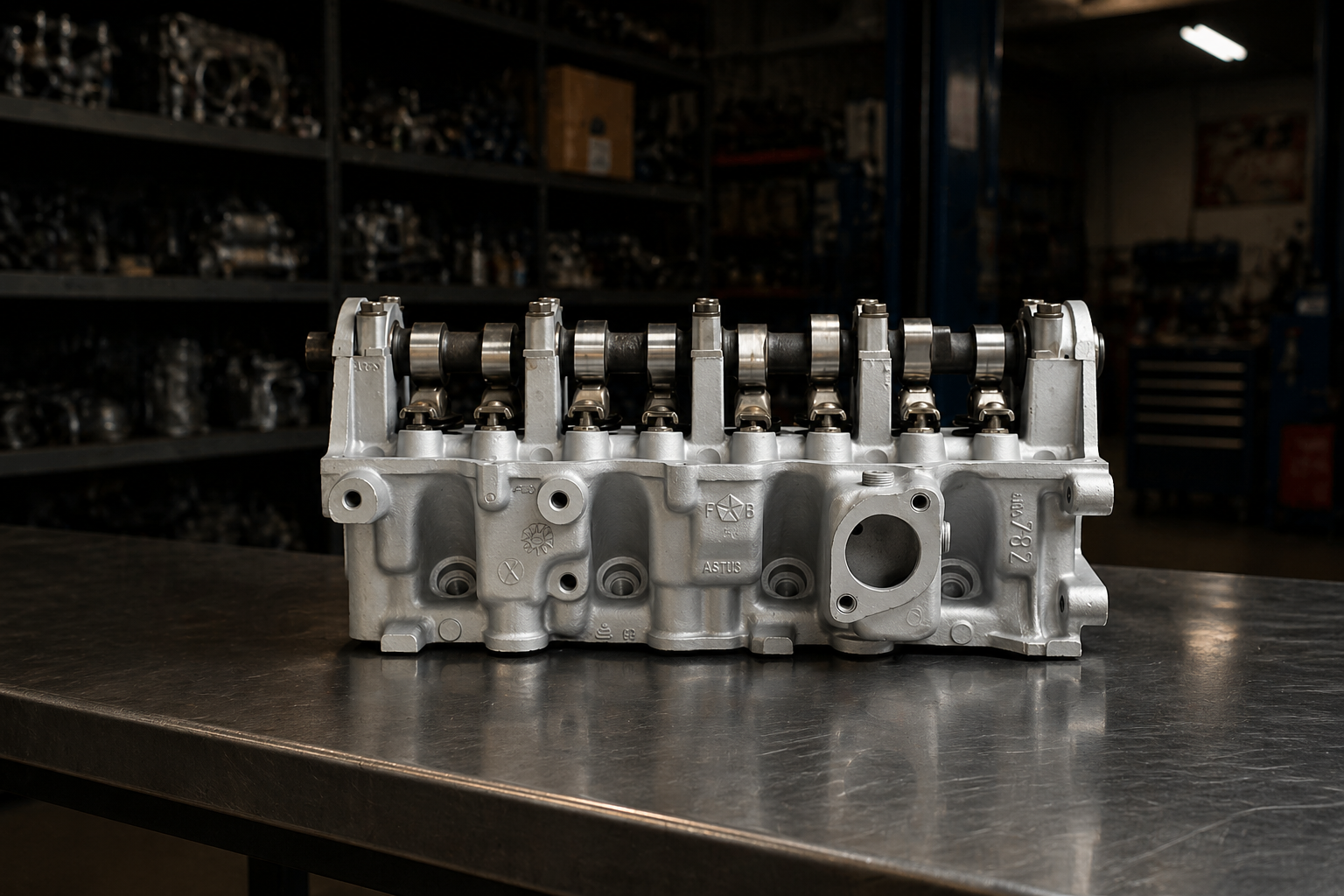
Identifying Turbo Dodge 782 cylinder heads in a crowded salvage yard or a Facebook marketplace listing is straightforward. You don't need a degree in engineering to spot the right one. Look for these specific markers:
There's a common misconception that 782 heads changed significantly between 1986 and 1995. While Chrysler made minor tweaks to the casting molds to clean up flash or improve coolant passages, the port geometry remained the same. A 782 from a 1989 LeBaron is functionally identical to one from a 1992 Spirit. Don't overthink the year. Focus on the condition of the cam journals and the deck surface. If the "782" stamp is there, you've got the right foundation for your build.
The 782 casting, widely known as the "Swirl" head, changed the performance landscape for Chrysler 2.2L and 2.5L engines starting in 1986. Before this, the older "Bathtub" heads relied on a more open chamber design that was prone to inefficient combustion. The 782 design introduced a specialized intake port that is physically offset. This offset forces the incoming air to rotate rapidly as it enters the cylinder, creating a vortex. This motion keeps the fuel droplets suspended in the air rather than puddling on the piston or cylinder walls.
This rotation is the secret to the 782's efficiency. By keeping the mixture in constant motion, the flame front travels across the chamber at a much higher velocity. This means the engine can extract more energy from the same amount of fuel. It also allows the engine to run more boost with a lower risk of engine-damaging detonation. When you are pushing 12 or 15 PSI through Turbo Dodge 782 cylinder heads, that controlled burn is what keeps your head gasket and pistons in one piece.
The heart-shaped combustion chamber is the most recognizable feature of this casting. Unlike the oval shapes of the early 1980s, this geometry concentrates the mixture around the spark plug. Chrysler engineers utilized a shrouded intake valve to promote high air velocity even at low lift intervals. This shrouding acts like a nozzle, directing the air into a specific tumble pattern. Fast Burn is the reduction in time between spark and peak pressure. Because the burn happens so quickly, you don't need to start the spark as early. Most 782 setups require significantly less ignition timing advance than the older G-heads, which reduces the negative work the piston has to do against a rising pressure wave.
Managing heat is vital when you understand how turbochargers increase engine power by compressing the intake charge. Compressed air is hot air, and hot air leads to knock. The 782's swirl effect prevents "hot spots" from forming in the corners of the chamber. This uniform temperature distribution was a massive advantage for the limited 1980s-era engine management systems like the Logic Module, SMEC and SBEC. These early computers weren't fast enough to adjust for cylinder-to-cylinder variances in real-time, so the mechanical efficiency of the head had to do the heavy lifting.
The 782 head features a 52cc chamber volume, which is a 6cc difference compared to the 58cc G-head. This smaller chamber bumps the static compression ratio by about half a point. This increase makes the car feel much more responsive when you aren't under boost, providing better torque for daily driving. If you're building a street-driven Shelby or Daytona, you'll appreciate that extra low-end grunt. If you need a fresh, professionaly rebuilt 782 (or 287)casting cylinder head for your build, you can find quality Turbo Dodge cylinder heads in our inventory to ensure your project stays period-correct and powerful.
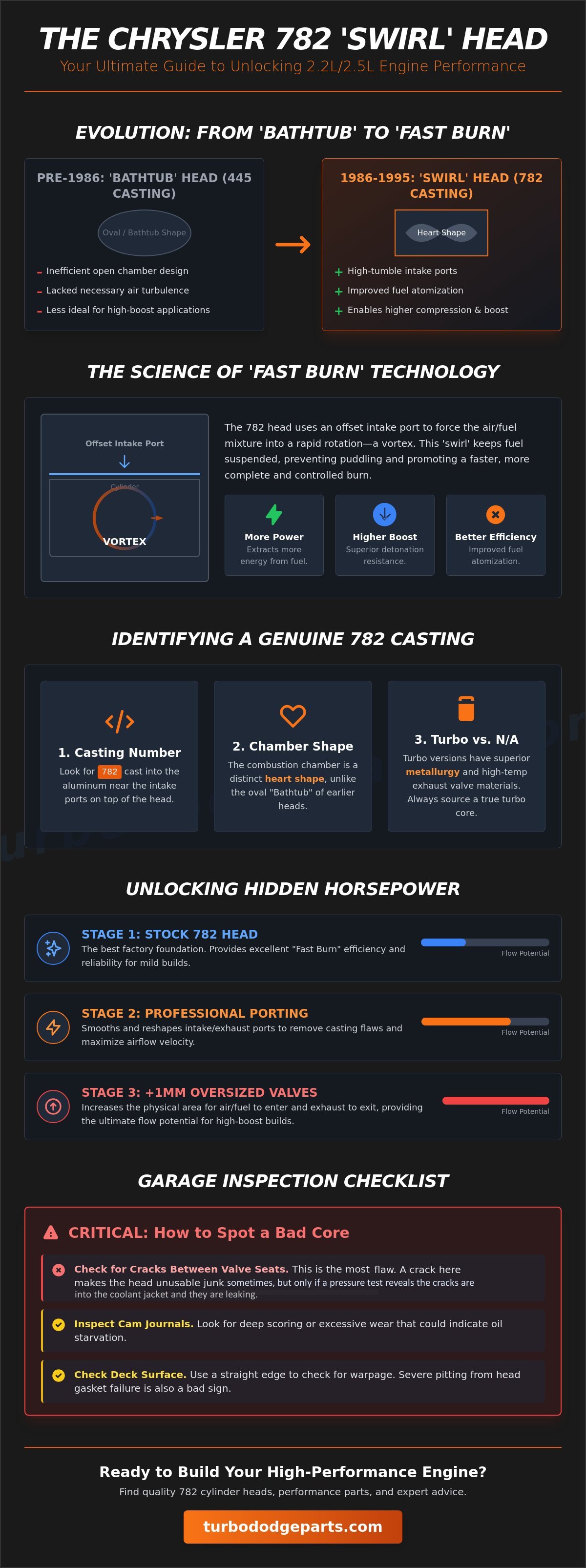
Many enthusiasts assume all Swirl heads are identical. This is a mistake that cavhikiikkkkn cost you an engine. While the 782 casting number appears on both naturally aspirated and turbocharged 2.2L and 2.5L engines, the internals are not the same. Chrysler engineers designed these heads for different thermal loads. You can't just pull a head off a base model Aries and expect it to survive 12 psi of boost on your Daytona without doing some homework first.
The primary difference lies in the exhaust valve metallurgy. Turbocharged engines generate significantly more heat than their N/A counterparts. To combat this, factory Turbo Dodge 782 cylinder heads came equipped with specialized high-temperature components. If you use a non-turbo head without upgrades, you risk valve failure within a few thousand miles of hard driving. The heat will eventually cause the metal to fatigue and fail.
Standard N/A heads typically use chrome-stem exhaust valves. These work well for daily commuting. Turbo applications require Silchrome or Stellite-faced valves to survive 1,400-degree exhaust gases. Stellite is a cobalt-chromium alloy designed for extreme wear resistance at high temperatures. Without it, the exhaust valve will beat itself into the head. This leads to valve seat recession. Once the seat recedes, your valve clearance disappears and your compression drops. This effectively ruins the head and kills your performance.
Cross-drilling is a specific cooling modification Chrysler introduced in 1987 for the Turbo II and later VNT engines. It involves small holes drilled through the deck of the head into the water jacket. These passages are located between the valves and the spark plug holes. This design helps pull heat away from the hottest part of the combustion chamber. It reduces the chance of detonation and prevents the head from warping under heavy load.
Converting a non-turbo head for high-performance use is a common practice. You must install the correct Stellite-faced valves and have a machine shop perform the cross-drilling. Don't skip these steps. Saving a few dollars on a cheap N/A head often leads to a melted piston or a cracked casting. Keep your Shelby Dodge running strong by using parts designed to handle the heat of a turbocharger.
Finding a "fast burn" 782 head at the yard or in a parts stash is a win. You still need to look closer before you bolt it onto your block. These heads lived through thousands of heat cycles in cramped engine bays like the L-body Chargers or Daytonas. Before you spend a dime at the machine shop, perform a thorough garage inspection to see if your core is actually worth saving. Use a bright light and a can of brake cleaner to strip away decades of oil and carbon.
Check the deck surface with a precision straightedge and feeler gauges. The factory tolerance for warpage on these 2.2L and 2.5L heads is 0.004 inches. If your gauge slides under at 0.006 inches or more, the head requires a professional mill. Look for "peppering" or tiny pits in the combustion chambers. This pitting is a clear sign of detonation damage from poor fuel or lean conditions. If the pitting is deep, it creates hot spots that cause even more knock later on. Don't forget to inspect the spark plug threads. High-boost applications often stress these threads, and a stripped hole requires a Time-Sert or Helicoil repair.
The number one killer of Turbo Dodge 782 cylinder heads is the hairline crack that forms between the intake and exhaust valve seats. This happens because of the extreme heat concentrated in that narrow bridge of aluminum. Most 782 heads show some level of surface cracking here. If the crack is shallow, a machine shop can often install oversized seats to fix it or more commonly peen over the crack to close the gap. However, if that crack reaches deep into the water jacket, the head is effectively scrap. You cannot skip the basics here. A professional pressure test is mandatory for any used 782 core before you start a high-performance build.
Remove the cam caps and pull the camshaft to inspect the journals. Scoring or deep grooves indicate the engine suffered from oil starvation or dirty oil. These heads don't use traditional bearings for the cam, so the aluminum towers take the brunt of the damage. Check the hydraulic lash adjuster bores for egg-shaping or excessive play. If the lifters fit loosely, you'll never get a quiet valvetrain and oil pressure will drop when the engine has reached operating temperature even or sooner. Pay special attention to both the front and rear cam cap seals. The O-ring seal here is a common leak failure point. If the seal is flat or brittle, oil will spray directly onto your timing belt (front seal) and ruin it. If the rear seal fails, it will pop out and spray engine oil out all over the drivers side of the engine and top of the transmission. Replacing these $5.00 dollar seals during inspection saves you a massive headache later.
Ready to rebuild your top end with the right hardware? Shop our selection of Turbo Dodge 782 cylinder head parts and gaskets to ensure your swirl head performs like it should.
Upgrading your Turbo Dodge 782 cylinder heads is the most effective way to see real horsepower gains on your 2.2 or 2.5 engine. While the stock swirl design is great for efficiency, it needs specific modifications to handle high-output builds. Professional porting unlocks the flow potential that Chrysler left on the table when these engines were designed in the mid-1980s. You aren't just looking for bigger numbers; you're looking for a better power band that stays strong through the entire RPM range.
Don't ever "clean up" or remove the swirl ramp in a 782 head. This is a common mistake that ruins the "Fast Burn" characteristics of the combustion chamber. If you grind that ramp away, you lose the turbulence needed for proper flame travel, which kills low-end torque. Instead, focus your efforts on the exhaust side. The exhaust port is the primary bottleneck of the 8v Chrysler engine. A specialized porter will focus on the bowl area and the exit to help the turbo spool faster. For those looking for a complete bottom-to-top solution, we recommend checking out our Turbo Dodge rebuilt engines to ensure your short block is as ready as your top end.
Buying a "junkyard find" is a massive gamble in the current market. These castings are now 35 to 40 years old. Most Turbo Dodge 782 cylinder heads found in local yards have hairline heat-stress cracks between the valve seats that you can't see without a magneflux test. A professionally rebuilt head from a specialist is pressure tested, surfaced, and crack-checked. It's a much safer investment for your Shelby or Daytona than a core that might end up being scrap metal after you've already paid for shipping.
When you push boost levels past 15 PSI, the stock head bolts and old-style composite gaskets often fail. The industry standard has moved to Multi-Layer Steel (MLS) head gaskets. These provide a superior seal for high-pressure environments. You must pair the gasket with ARP head studs or ARP head bolts. Unlike stock bolts that are designed to stretch, ARP studs provide consistent clamping force. This ensures your head stays sealed to the block even under heavy load. This combination is a mandatory upgrade for any high-performance 782 installation.
The 782 swirl head remains the essential foundation for Chrysler 2.2L and 2.5L engines produced from 1986 through 1995. You now understand how Fast Burn technology optimizes the combustion process and why distinguishing between turbo and non-turbo castings is critical for long-term durability. Proper inspection prevents the common failure points that often plague these decades-old components. Don't risk your engine's health on a mystery junkyard find or a generic rebuild that doesn't account for high-boost heat cycles.
We focus exclusively on the 1980s and 90s Chrysler turbo platforms to give your L-body, G-body, or P-body the specialized attention it deserves. Our shop provides custom-manufactured performance components that meet the exact tolerances required for Shelby Dodge restorations. If you have questions about your specific build, you can reach out for expert technical support from Steven at Turbo Dodge Parts. We've spent years perfecting the Turbo Dodge 782 cylinder heads to ensure they handle modern street and track demands.
Ready to finish your project? Shop Professionally Rebuilt Turbo Dodge 782 Heads and get your car back on the pavement where it belongs! We're excited to help you keep these legendary turbo machines alive and running strong.
Yes, you can bolt a 782 head onto a 1984 2.2L block, but it significantly changes your compression ratio. The 1984 2.2L engines used flat-top pistons with the 445 bathtub head. Swapping to the 782 swirl head drops the chamber volume and increases compression from 8.1:1 to approximately 9.5:1. You'll need to run high-octane fuel or adjust your ignition timing to prevent engine knock.
A stock 782 cylinder head features a combustion chamber volume between 48cc and 50cc. This compact "fast burn" design is smaller than the earlier 445 or 655 castings, which typically measure 58cc. If you resurface the head, remember that removing .010 inches of material reduces the chamber volume by about 2cc, which further increases your static compression ratio.
A stock 782 head generally handles 14 to 18 psi of boost before the risk of lifting the head off the block becomes a concern. For builds pushing past 20 psi, you should replace the factory 11mm bolts with ARP head studs. These studs provide the consistent clamping force needed to keep the head gasket sealed under high cylinder pressures common in modified Turbo II setups.
You can repair cracks between the valve seats on Turbo Dodge 782 cylinder heads, but it's often unnecessary for street use. Almost 90 percent of used 782 castings show small surface cracks between the intake and exhaust valves due to extreme heat cycles. Unless the crack extends deep into the water jacket or causes the valve seat to loosen, the head remains functional for most applications.
The Mopar Performance P4452006 head gasket is the best choice for a 86+ cross drilled 2.2 or 2.5L Turbo engine using a 782 head. But this factory head gasket is no longer available, so instead substitute the later version FelPro Permatoque 9296PT or our even better and stronger MLS 'Metalmix' Cylinder head gasket for high performance, high boost engine applications. Our Metalmix cylinder head gaskets are manufactured in Italy (not China) and are a significant step up from the FelPro Permatorque gasket. The standard gasket specs are 1.0mm thick and this gasket is specifically designed to handle the increased cylinder pressure of turbocharged 2.2 and 2.5 engines. It features a reinforced fire ring that provides a superior seal compared to standard replacement gaskets found at local parts stores.
You must change your ECU or update your calibration when switching from a bathtub head to a swirl head. The swirl design burns fuel much faster, so it requires about 10 degrees less total ignition advance than the older 445 and 287 heads. If you run a bathtub head computer with a swirl head, the aggressive timing curve will likely cause detonation and damage your pistons.
Torque the 782 head in three distinct steps: first to 45 foot-pounds, then to 65 foot-pounds, and finally add an additional 1/4 turn (to 95 foot-pounds). Use the factory sequence starting from the middle two bolts and working in a cross pattern toward the outer edges of the head. Always lubricate the bolt threads with clean engine oil to ensure you get an accurate torque reading during the final 95 foot-pound pass.
The 782 head is compatible with all 1984 to 1993 EFI intake manifolds, including both one-piece and two-piece versions. While it doesn't require a unique manifold, most enthusiasts pair it with the 1987 or later one-piece intake for ease of maintenance. Just ensure you use the correct intake gasket for your specific manifold type to prevent vacuum leaks at the cylinder head ports.