
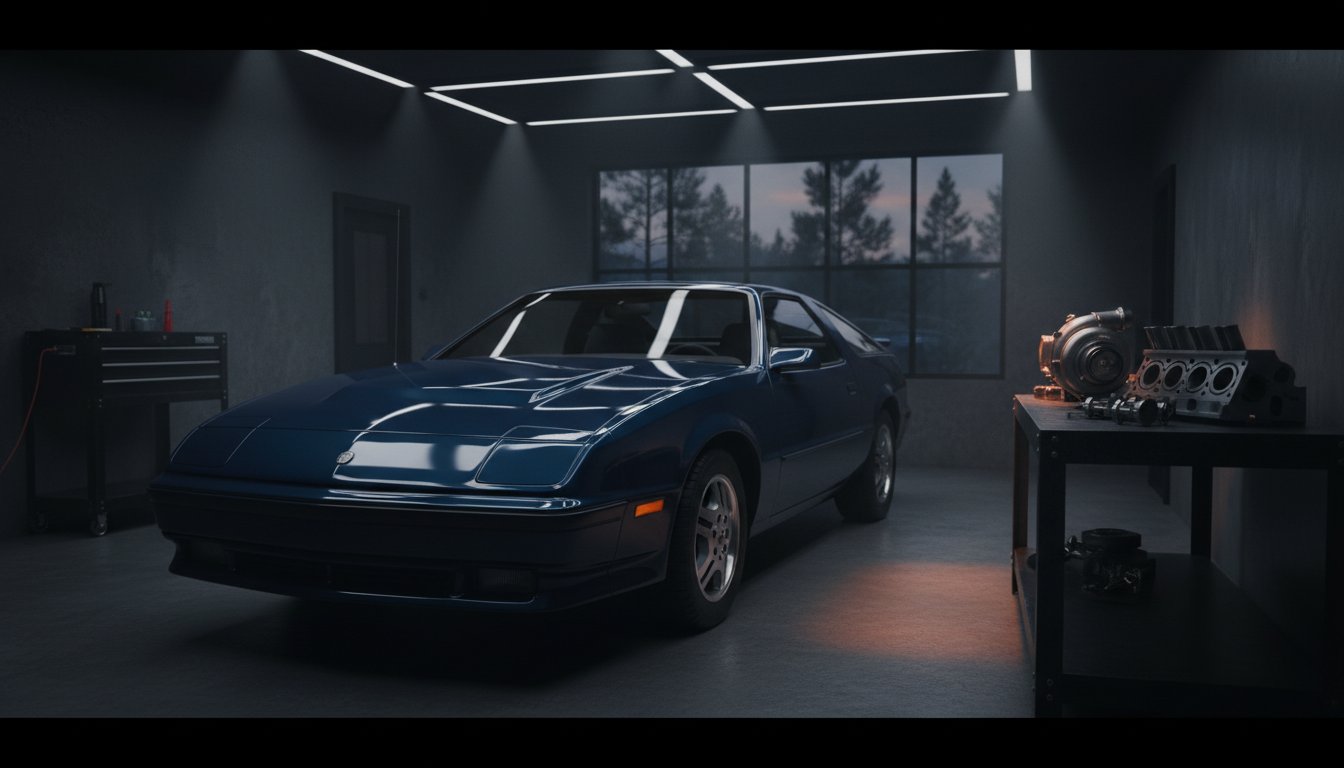
Last Tuesday, a dedicated Daytona owner spent three hours searching major retail sites only to receive the same "Part Discontinued" notification for a Dodge Daytona T2 IAC Valve or even a 5 speed shifter cable. It's a scenario that plays out daily for owners of 1980s and 90s Turbo Dodges. You've likely felt that same sinking feeling when a generic site doesn't even list your specific model year. We understand that keeping a classic Shelby Dodge on the road requires more than just luck; it requires specialized knowledge. Finding high quality car parts for these legends shouldn't feel like a dead-end search.
You deserve a reliable way to keep your 2.2L or 2.5L engine at peak performance without settling for questionable used junk. This guide will show you how to source custom-manufactured components, and known to fit and function properly parts and verify the fitment of 40-year-old mechanical spares, and secure performance upgrades. We'll walk through the current 2026 landscape of specialized vendors and provide the technical specs needed to ensure your wheel bearing replacement, front strut upgrade, transmission conversions and even engine builds are successful from the first turn of the key.
Finding the right car parts for a 1986 Shelby Charger or a 1991 Spirit R/T is getting tougher every year. We focus specifically on the vintage performance niche of 1980s and 1990s Chrysler-era turbo platforms. This guide covers passenger cars including the L-body, K-car, G-body, and J-body families. We don't include trucks or vans here. These vehicles rely on the Chrysler 2.2L and 2.5L engine family, which requires extreme mechanical precision. When you're pushing high-boost levels through a 40-year-old block, "close enough" fitment leads to catastrophic failure. You need components designed for the specific heat cycles of a turbocharged environment.
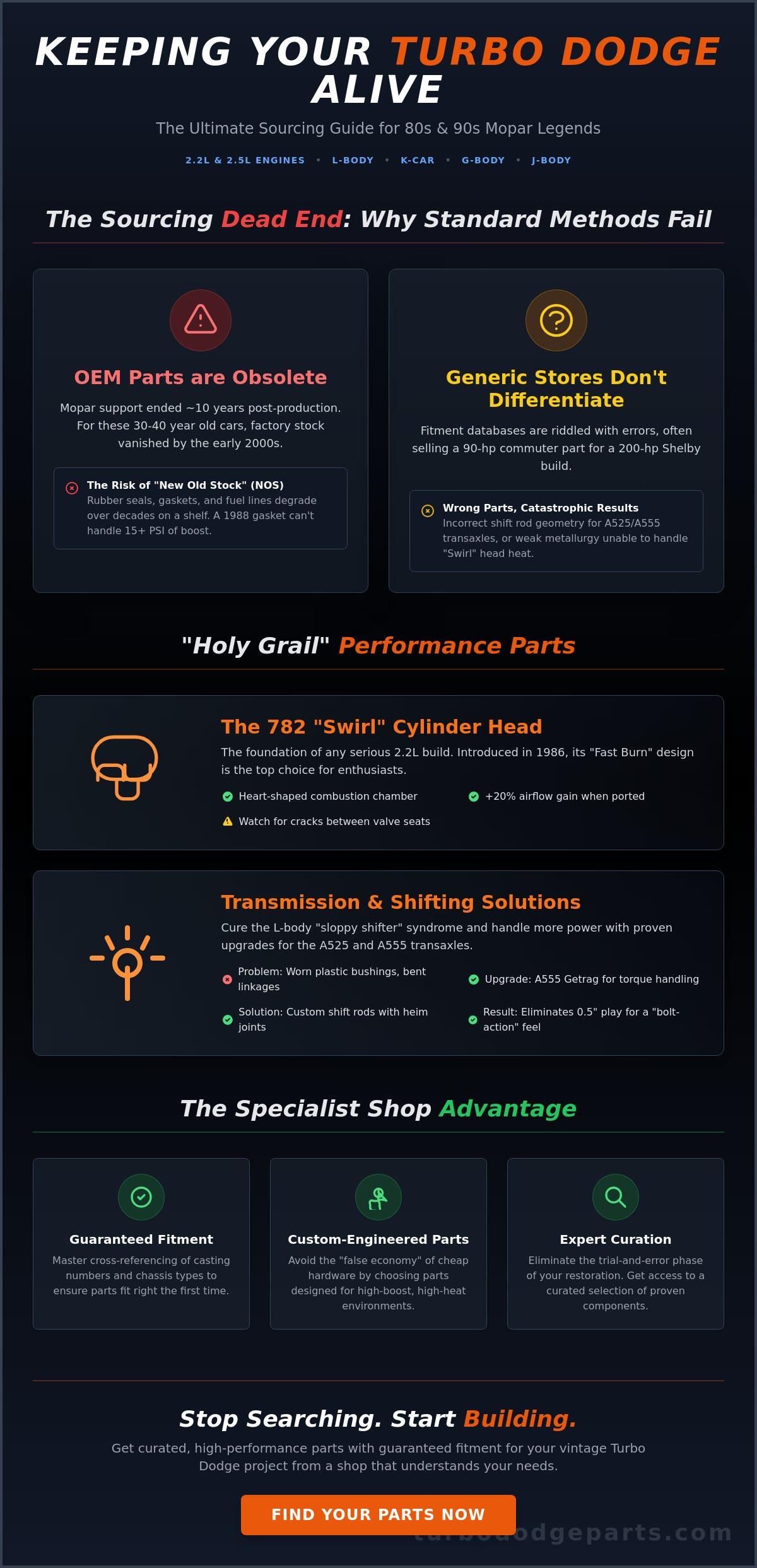
Mopar typically supports parts for about 10 years after a vehicle leaves the assembly line. For these 30 to 40-year-old cars, factory support ended decades ago. Dealerships cleared out their remaining inventory by the early 2000s, leaving a massive gap in the market. Today, the community relies on specialized parts hunters and dedicated enthusiasts who stockpile rare components. Even New Old Stock (NOS) items present risks. Rubber seals, gaskets, radiator hoses and fuel lines manufactured in 1988 have likely degraded while sitting on a shelf. Brittle rubber cannot handle the 15+ psi of boost common in modified T2 or T3 setups. You have to be careful when sourcing car parts that have been sitting in a warehouse for 35 years!
Generic auto parts stores often fail the Turbo Dodge community because their fitment databases are riddled with errors. These systems frequently confuse a base model Omni with a GLH or GLHS. They might sell you a standard-duty water pump or a weak alternator that wasn't built for the higher demands of a performance turbo build. Mass-market manufacturers ignore niche geometry. We often see issues with shift rod and cable for the A525 and A555 transaxles where generic replacements simply don't align correctly. Standard-duty components often lack the metallurgy required for the intense thermal loads of a "Fast Burn" or "Swirl" head. Using parts designed for a 90-horsepower commuter car on your 200+ horsepower Shelby is a recipe for a breakdown.
Restoring a Shelby Dodge or a turbo Chrysler requires a focus on specific car parts that defined the 1980s performance era. The "Holy Grail" of any 2.2L or 2.5L build is the 782 cylinder head and a properly clocked, rebuilt turbocharger. These engines rely on high-spec cooling and oiling systems to survive the heat generated by increased boost. If you plan to push past 14 psi of boost, high-quality forged internals become a requirement rather than an option. When sourcing aftermarket upgrades, ensuring they meet Federal motor vehicle safety standards (FMVSS) is crucial for street legality and component reliability. For those seeking specific components, browsing a curated selection of specialized engine components can save hours of forum digging.
Here are some of the turbo Dodge Specific parts vendors that you might consider sourcing the correct parts for your turbo Dodge from:
Introduced in 1986, the 782 "Fast Burn" or "Swirl" head is the preferred choice for most enthusiasts. Its heart-shaped combustion chamber improves flame propagation and fuel efficiency. When you're hunting for a used 782, check for the common cracks between the valve seats; this is a frequent failure point in high-mileage castings. A professionally ported 782 head can increase airflow by 20 percent, allowing the engine to breathe much better at high RPMs. It's the foundation of any serious 2.2L power plant.
The "sloppy shifter" syndrome is a rite of passage for L-body owners. The early A525 transmissions often feel like stirring a pot of soup due to worn plastic bushings and bent linkages. Upgrading to the A555 Getrag-based transaxle, found in 1987 to 1989 Shelby models, offers significantly better torque handling. Custom-manufactured shift rods with heim joints are superior to factory linkages. They eliminate the 0.5-inch play common in old setups, providing a bolt-action feel that restores driver confidence during hard shifts. These custom made, fully assembled, ready to install shift rods are available here at Turbo Dodge Parts(.com)
Distinguishing between T1 and T2 setups is vital when buying car parts for your forced induction system. The T1 uses a non-intercooled "log" or "blow-through" intake, while the T2 features an intercooler and a Garrett T03 turbocharger. Sourcing a reliable wastegate actuator is the only way to maintain consistent boost control and prevent engine-killing overboost spikes. Avoid universal turbo components. These engines use specific manifold flanges and clocking positions that make "one-size-fits-all" parts nearly impossible to install without extensive fabrication.
Turbocharged Chryslers run hot. You need a radiator with at least a 2-row core and an oiling system that can handle the thermal breakdown caused by the turbo's center section. If your build goals exceed 200 wheel horsepower, factory cast pistons won't suffice. Forged pistons and heavy-duty connecting rods are essential for longevity. These parts provide the structural integrity needed to handle the cylinder pressures of a tuned 2.2 or 2.5L stroker engine without the risk of ring land failure.
Choosing the right car parts for a 40-year-old Shelby Charger or Omni GLH requires a tactical approach. You can't just walk into a local chain store and expect high-performance quality for a high-boost application. Most OEM stock for these vehicles dried up years ago. This leaves you with three choices: generic aftermarket, salvage, or custom-engineered components. The Specialty Equipment Market Association (SEMA) highlights how the specialty aftermarket is vital for vehicle preservation; however, not all components meet the same standards. Enthusiast-engineered parts often use modern materials like 6061 aluminum or high-grade steel that original Chrysler engineers couldn't budget for in the 1980s.
Don't fall into the "false economy" trap. It's tempting to save $50 on a generic fuel pump or a budget head gasket. On a naturally aspirated grocery getter, that's fine. On a T2 setup pushing 14psi, a cheap part is a liability. A lean condition caused by a sub-par pump will melt a piston in seconds. We've seen generic suspension bushings disintegrate in less than 5,000 miles because they weren't designed for the heat and torque of a modified or even a stock turbo Dodge. Safety is another major factor. When you're replacing steering racks or ball joints, generic parts often lack the metallurgy required for aggressive driving. Custom or high-end enthusiast parts are often durability-tested on actual track cars within our community, ensuring they outlast the originals.
Some car parts are simply non-negotiable because they're no longer produced by any major manufacturer. If you're upgrading an L-body from the weak A525 transaxle to a stronger A555, you need specific conversion brackets. These don't exist in the generic world. Custom manufacturing solves 40-year-old engineering flaws that the factory never addressed. These "improved-over-stock" designs are essential for a reliable 2026 build.
While salvage yards are great for finding window glass or interior trim, they're risky for critical mechanicals. Consider these factors before pulling used engine components:
Stick to the yards for the hard-to-find cosmetic pieces, but trust specialized, tested sources for anything that moves, rotates, or holds pressure.
Getting the right car parts for a 1980s Mopar requires more than just knowing the model name. Chrysler used a modular approach during this era, but subtle engineering shifts between 1984 and 1993 mean parts often look identical while being functionally incompatible. You've got to be precise to avoid "garage floor frustration" when a bolt hole is off by three millimeters.
Step 1: Identify your specific chassis. L-bodies like the Dodge Omni GLH and Shelby Charger use unique suspension components and shift linkages compared to K-car derivatives. If you own a Dodge Daytona (G-body) or Chrysler LeBaron (J-body), your car parts often swap between those platforms, but they won't fit an Omni. L-body CV axles, for example, are specific lengths that don't share dimensions with the wider K-chassis cars.
Step 2: Cross-reference engine year and head casting numbers. Don't just buy a "2.2 Turbo head." Look for the three-digit casting number. A 287 "Bathtub" head from a 1984 or 1985 Turbo I engine has different combustion chamber shapes and cooling passages than a 1986 or later 782 "Swirl" head. Mixing these up without adjusting your ECU calibration can lead to detonation issues.
Step 3: Verify your transmission type. Before ordering a clutch or shifter bushings, confirm if you have an early A525 or a later A520, A555, or A568 cable-shift transmission. Spline counts on the input shafts vary between 18 and 21 depending on the year and the torque rating of the transaxle.
Step 4: Consult with a specialist. The "parts bin" history of 80s Chrysler means a 1989 Dodge Spirit might share a MAP sensor with a 1991 Shadow, but the vacuum port orientation could be different. A specialist who knows these cars can tell you exactly which year-to-year changes affect your specific VIN.
The 1989 model year is a major hurdle. This was the transition to the "common block" design. If you're sourcing components for an engine rebuild, remember that 1988 and earlier blocks use different crankshafts, oil pans, and even water pumps and accessory drive components and fan belts than 1989 and later versions. They aren't interchangeable. Also, don't assume TBI (naturally aspirated) blocks are the same as Turbo blocks. Turbo blocks feature dedicated oil return ports and specific oil galley drillings that TBI blocks lack. Even a Dodge Spirit and a Dodge Daytona with the same 2.5L engine might have different radiator hose routings or cooling fan clearances.
You need a Factory Service Manual (FSM) for your specific vehicle year. Aftermarket manuals are too generic for turbo-specific vacuum diagrams and torque specs. Use digital calipers to verify shaft diameters and bolt patterns before clicking "buy." A 5x100mm bolt pattern looks nearly identical to a 5x114.3mm pattern, but they won't swap. Building a personal connection with a specialist shop saves you hours of research. We've spent decades documenting these 2.2L and 2.5L variations so you don't have to guess on your build.
Buying car parts from a massive, multi-brand warehouse often leads to frustration. These retailers treat a 1987 Shelby GLHS like any other 40-year-old econobox. A specialist shop operates with a different mindset. Every component in this inventory is curated by an expert who actually turns wrenches on these specific machines. This expert oversight eliminates the trial and error phase that stalls 75% of vintage restorations. You receive verified components that bolt up correctly the first time, preventing the need for "hack-job" modifications that ruin a clean engine bay.
Specialized car parts do more than just fix a mechanical failure; they preserve the historical integrity of your vehicle. For a rare Shelby model, such as the Omni GLH Turbo, GLHS Shelby and Omni, Spirit and Daytona RT and yes the Daytona Shelby Z, Shelby Lancer and CSX Shadow, using the wrong bracket or a generic sensor can decrease its market value. We provide access to "Customer Reserved" items and custom-manufactured inventory that is unavailable through standard commercial channels. These are parts built to original 1980s specifications or improved for modern reliability using 2026 manufacturing standards without losing that period-correct aesthetic.
Our focus remains strictly on the 2.2L and 2.5L platforms. You won't find your search results cluttered with 1500-series truck parts or generic minivan accessories. It's a streamlined experience for the dedicated turbo Dodge 2.2 and 2.5 enthusiast. If you have a technical question about a T1 intake or a bathtub head, you get a direct answer from the owner. We also maintain a "Garage Sale" section. This is where budget builders find rare treasures and used components that still have plenty of life left. It's a practical way to keep your project moving without the high cost of new-old-stock items.
Sourcing the right components is part of a larger mission to save automotive history. These cars represent a unique era of Chrysler performance, and keeping them on the road requires a partnership. I'm here to help you navigate your build. If you're stuck on a vacuum routing issue or a fuel rail fitment problem, reach out via cell or email for personalized assistance. Let's make sure your Dodge stays fast and functional for the next generation of enthusiasts.
Take the next step in your restoration: View our specialized inventory of Turbo Dodge parts.
Restoring a vintage Chrysler 2.2L or 2.5L engine requires more than just luck; it demands specialized knowledge of the L-body and K-car chassis. Since the 1980s, finding reliable car parts for these 1980s and 90s performance vehicles has become difficult as OEM stock disappears from warehouse shelves. You shouldn't settle for generic components that fail to meet the original 1984 through 1993 factory specifications. Focus on custom-manufactured hardware designed specifically to replace discontinued items. This ensures your build maintains its mechanical integrity and historical accuracy.
Turbo Dodge Parts has specialized in these engine platforms since the 1980s. We provide custom-manufactured hardware for discontinued OEM components and offer expert technical support directly from our dedicated shop owner. Whether you're working on a T1 intake or a swirl head project, you'll get the precision your car deserves. Don't let your project stall because of a missing bolt or a worn-out gasket. We're ready to help you get back on the pavement.
Find the exact mechanical car parts for your Turbo Dodge build here!
You can source specialized car parts for the L-body Omni GLH through niche vendors like Turbo Dodge Parts or via the TurboDodge.com forums. Many mechanical items like 1984 through 1986 T1 engine components are still available through specialty warehouses. For body-specific trim or GLH decals, you'll need to look for custom-manufactured reproductions or 40-year-old salvaged stock from private collectors.
Most top-end components like the 782 swirl head and intake manifolds are interchangeable between the 2.2L and 2.5L blocks. However, the 2.5L uses a taller block with 10mm longer connecting rods and a unique crankshaft to achieve its 104mm stroke. You can't swap the rotating assembly or the timing belt between these two displacements because the 2.5L requires a 135-tooth belt while the 2.2L uses a 122-tooth belt.
The 782 Swirl head features a heart-shaped combustion chamber designed for fast-burn efficiency, while the 445 and 287 Bathtub head uses a more open, oval chamber design. Chrysler introduced the 782 casting in 1986 to improve low-end torque and emissions. If you're building a high-horsepower T2 setup, the 782 is the standard choice for 95% of enthusiasts due to its superior flow characteristics and knock resistance.
No, national chains like AutoZone or O'Reilly don't stock 1984 through 1990 L-body shift rods or the associated linkage bushings. These specific car parts were discontinued by Mopar in the late 1990s. You must purchase fully assembled, pre-adjusted steel replacements or heim-joint upgrades from TurboDodgeParts.com who manufactures them specifically for the A525 or A555 manual transmissions found in the L-body (Charger, Omni, TC3, Horizon, Scamp, Rampage) cars.
Sloppy shifting is usually caused by perished plastic bushings in the shift linkage or a loose selector shaft bracket or a loose shifter lever pin in the transaxle bracket. You need a complete shifter bushing kit, which typically includes 4 to 6 individual nylon or Delrin pieces. If you have an A525 transmission, check the 2 internal shift rail pads. Replacing these 30-year-old plastic components will restore the crisp, mechanical feel your Shelby originally had.
You cannot use Dodge Ram truck parts for engine or drivetrain repairs, as the 2.2L and 2.5L engines share 0% architecture with the truck-based 3.9L or 5.2L engines. The only exceptions are minor electrical connectors or specific 12-volt relays used across the entire 1988 through 1993 Chrysler lineup. Always verify the 8-digit Mopar part number before attempting to cross-reference components between platforms.
Authentic New Old Stock (NOS) parts arrive in original Chrysler, Mopar, or Shelby boxed packaging with a printed manufacturing date. Aftermarket parts are modern reproductions made by third-party companies and usually feature updated materials like silicone instead of rubber. Look for the pentastar logo stamped directly into the casting or plastic; if it's missing, the part is almost certainly a 21st-century reproduction.
You must replace the intermediate shaft bearings, the head bolts, and the oil pump during any 2.2L overhaul. The intermediate shaft bearings are prone to 100% failure if the oiling holes aren't aligned perfectly during installation. Always use Mopar 005/006 head bolts or ARP studs because the factory bolts are torque-to-yield and cannot be reused. Replacing the 40-year-old timing belt tensioner is also mandatory.